
Before I have tried beekeeping, I was a bit overwhelmed by the things I needed to know and have to start. The internet was full of posts about starting beekeeping but none of the posts were really complete. So I had to go from one post to another to get some kind of a bigger picture. And that is the reason why I published this post – so you have a simple resource available to use on how to start beekeeping.
So let me guide you through all the steps you need to go through to enter the fantastic world of honeybees: planning stages, education, getting the basic equipment, starting a hive, your first season, your second season, protection, all of that will be covered in this guide. You will notice quite a few links to other posts. The reason is that I will try to link to other useful resources on my and other blogs to make sure that you get complete information that you need to start beekeeping.
Here are the overall steps you need to go through while starting beekeeping:
- Plan and prepare
- Understand the time needed
- Choose the location
- Prepare for the long term
- Find your preferred way of learning
- Get the basic equipment
- Beehives
- Protective gear (bee suit, veil, gloves)
- Bee smoker, bee brush
- Honey extraction
- Start a colony
- Learn during the first two years (seasons) of beekeeping
- Take care of the health of your bees
Plan And Prepare
Before you venture into this beautiful and somewhat “weird parenthood” relationship with honeybees, it’s good to start by learning a bit more about it. Seeing as you are reading this guide means you did the best thing possible; information gathering. Beekeeping is not rocket science, but it does require the basic understanding about how bees make honey, what colonies require to thrive, and what are the hurdles that you have to overcome to keep the bees happy and safe. And here we start with the basics.
Understand the time needed
Another thing to consider is incorporating bees into your life time-wise. Bees, like all creatures, require love and attention to really thrive. If you feel like you can’t devote a couple of hours a week attending to their needs and checking up on them, it should be weighed into your decision making.
It sounds like a burden, but this is where talking to experienced beekeepers comes into light. Many beekeepers have their own philosophy on what’s best for bees, how they should be supported and what not to do, but we all agree: it’s almost impossible to go wrong if you simply devote just a couple of hours a week to it.
Choose the location

Bees need nectar to produce honey which they instinctively stock to be able to live through the winter and keep the colony alive. Nectar can be derived from all sorts of plants and trees and you would be amazed by the honeybee’s ability to find sources of nectar even in the most urban environments. But it would behoove you to plan on providing bees with plenty of open space that they can safely explore.
Close to nature – away from people. That is the general rule. Bees are not pre-dispositioned to be aggressive towards people, but they get into our way and more importantly, we get into theirs. So, during your planning stages, take into consideration that you need adequate space to keep your beehives, especially if you are looking to keep more than a couple of them. Also, make sure to inform your neighbors that you are going to keep bees so they are aware of it and keep pesticides to a minimum.
Prepare for the long term
Lastly, don’t plan on doing it a year or two. I am serious with this one and every time I say you will fall in love with it; I’m not even half-joking. So, if your thinking is: I will try it and if I don’t like it, move on.
I’m saying this for a couple of reasons. First one; I highly doubt it you will be able to leave it after a year because you learn something new and interesting (I would even dare say magical) every week. And the things you learn are: how to love your life and understand it better (again, not even kidding!). It’s like saying: Oh, I will get the smartest and sweetest puppy in the world, and then give it away to someone after a year.
The second reason: if you are in it for the short run (meaning you wouldn’t mind giving it up and you just want something to keep you occupied for a while), learn to fly fish or start golfing. Beekeeping is not “that kind” of an activity. Because your bees will suffer if you abandon them (meaning if you don’t do it properly) I would like you to have a designated person that can take them over if you, for any reason, decide to quit. And that’s all you need to plan for, the rest will come sort of “on the fly”.
Must read posts when planning and preparing for beekeeping:
- How much work is beekeeping?
- When is the best time to start beekeeping?
- How many beehives can one person manage?
Find your preferred way of learning
There are many approaches you can take here. Individual research seems to be the path you are currently on, and it’s a good path. And the great thing about it is that discovering great books, guides, resources – leads you to discover and meet people who are knowledgeable and experienced beekeepers.
And it’s a great way to acquire all the necessary knowledge you need. You can also take a different approach and start by having a chat with someone who already is a beekeeper. Meeting a couple of them will inevitably lead you to a path discovering amazing books, guides, and resources too.
Yeah, my point is, beekeeping community is absolutely welcoming and basically everything; every piece of knowledge and experience is available to novice beekeepers in the same fashion as it is to the 40-year veterans and industrial beekeepers. Even the scientists studying bees for decades can learn a thing or two when talking to a first season beekeeper. And the reason for it stems from the second learning system: trial and error.
Although some beekeepers will claim: I never made a mistake; chances are, it’s not true. We all make mistakes and those can come in many different forms. I can name a couple of instances where I almost decimated an entire colony just by trying new stuff and experimenting. Get ready to be wrong some of the time but have comfort that it’s a rare occurrence and every mistake you make will serve you well to learn valuable lessons.
I’ll encourage you to ask questions. Whatever they may be. Ask me, ask a friend, ask on the internet, send a letter to the biggest expert on bees in the world asking him to explain why you shouldn’t assess the colony’s health based solely on traffic, chances are, you will get an explanation! Beekeepers love to share their knowledge. It’s comparable to parents discussing their kids’ success: My oldest just got a scholarship to Notre Dame and my youngest is the national spelling bee champion… You will quickly figure it out.
Getting the Basic Equipment
Now let’s take a look at what equipment will you need to start beekeeping on the right track. My recommendation is the following – get a few beehives, protective gear (bee suit, veil, gloves) bee smoker, bee brush, and harvesting equipment or at least a plan about how you are going to harvest honey.
Beehives
There are a couple of types of hives you can choose from. The hives differ in capacity and functionality and picking the one start with is a highly preferential thing. The most popular choices are the Langstroth Hives, Top bar hives, and Warre Hives. You can learn the differences between them in this neat guide I created not so long ago. Click here: Most popular beehive types explained.
There are two main things defining a hive. Body and frames (or bars depending on the type). There are a few other elements, but I want you to focus on these two. If you are planning to harvest the honey regularly, get spare frames. It will make your life way easier and ultimately result in less stress for your bees when harvesting time comes.
Protective gear
Although you will meet people who don’t use any protective equipment, trust me on this; they all still have it! Protective equipment is not there just to protect yourself from the bees. It also protects the bees. I’ll keep it brief.
Bees love tight spaces where they can crawl in explore (hence the hive boxes). Not wearing protective gear allows the bees to crawl under your shirt, into your sleeve, and ultimately, one of them is bound to either get crushed or hurt or simply panic and sting you.
And to be honest, being stung by bees is not the worst thing to experience from time to time, but you ought to know that a hurt bee releases pheromones that alerts other bees and makes them aggressive, which leads to a chain reaction ending up in many hurt bees (not to mention yourself). Protective gear is there to keep everyone safe, and calm. So, Veil, Suit, gloves, get them. Use them. At least at the beginning.
Useful posts about protective equipment and safety:
- 10 Safety tips for beginning beekeepers
- Why do bees become aggressive and how to calm down you beehive
Bee Smoker, Bee brush

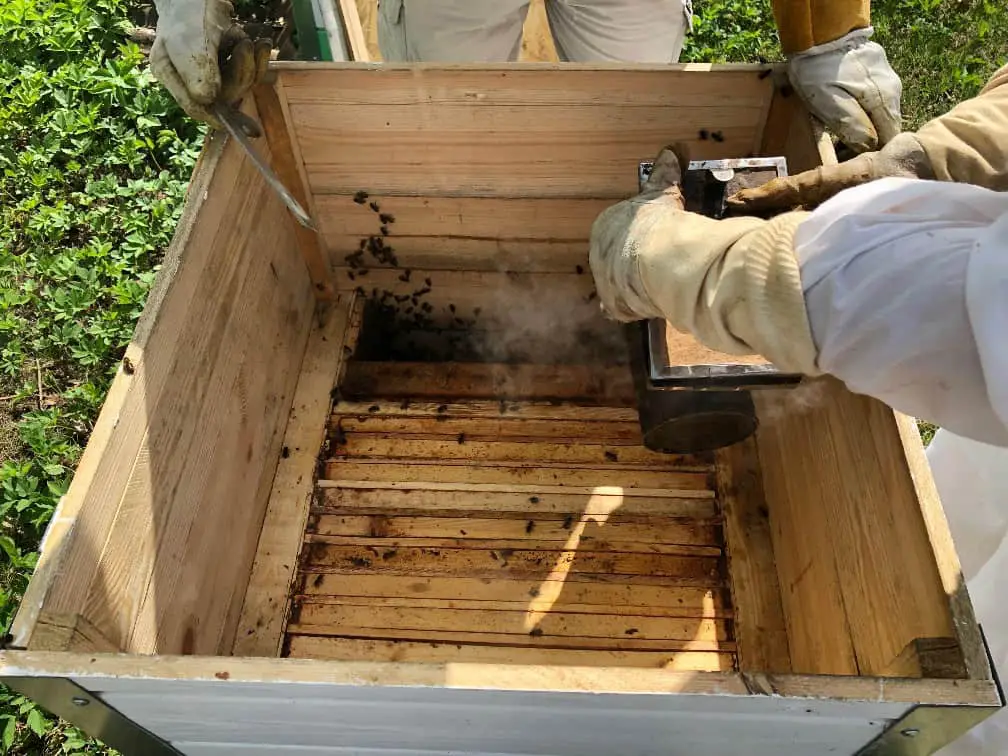
Speaking of calm, these three things are good to have, especially the smoker. Smoking bees is a process where you distract the bees by using smoke. Smoke does two things; it masks the pheromones in the air released by guardian bees who are alerted to your presence and perceive you as a danger to the colony (or as I mentioned by crushed and hurt bees) and it also triggers a response in bees that makes them retreat into the hive (and out of your way).
When they sense the presence of smoke, bee’s natural survival instincts kick in and in preparation for the inevitable evacuation (since smoke for millions of years meant forest fire), the bees gorge themselves on honey and are completely un-phased by a pesky human raiding their stocks.
While the bee smoker is a must-have, bee brush and bee blower are somewhat preferential and you can use them, but you can also live without them. The good thing is that brush quite literally costs like a pack of gums. Blowers can get a bit more expensive, depending on the type.
Recommended posts about bee smokers and bee brushes:
- Why do beekeepers use smoke
- How to light and use a bee smoker
- 5 best bee brushes and how to pick the right one
Equipment needed for honey extraction
This is where you will have the most freedom. There are basically no rules when it comes to extracting honey (in terms of method, not timing and the way you handle the hive). If you are starting with only one or two hives, you don’t need much.
A couple of food grade buckets, a couple of spare frames, and a hot butter knife. You can uncap the combs and leave honey to drip out for days. But at some point, having a honey extractor will sound a lot more reasonable. Again, there are a couple of types you can choose from but the good old hand-cranked bucket extractor that can fit a couple of frames is what you want to get.
Keep in mind that extracting honey can get a bit messy and that honey has a very strong smell (to bees at least) and leaving your frames outside (stacked with honey)… Let’s just say bees are more than willing to take back what’s theirs. So, a dedicated room for honey extraction is a good thing to have.
There are plenty more pieces of equipment (you can check this post out to see the full list – beekeeping equipment list), some of which you will need more than others, some of which you can go without for decades (for example electric bee blower?), but you will learn all about that stuff along the way.
Start a colony
Ok, you are all set up, got the hives, got the suit, got the mega-ultra honey extractor 2000, now what? It’s called beekeeping for a reason; you need bees to keep. This is where you would want to seek out help the most.
Setting up your first hive can be tricky, and there are some tips I can give that would apply to any kind of set up you have. There are two main ways to start a colony, natural swarming, and artificial swarming. I suggest picking the second one if you are doing it for the first time. It’s just easier to buy a fully set colony core, nucleus packs, pre-selected queens and many other things that make setting up colonies way easier than natural swarming.
Catching a swarm (natural swarming) requires a certain level of skills and calmness to do it successfully, so I would suggest waiting to at least your second season to attempt natural swarming. Also, this method is not something that you can plan for ahead. Natural swarms do occur, but you cannot actually predict them as successfully.
Starting new colonies is a spring process. You can do it basically any time other than winter, but you wanna do it in the early spring when you are certain that the winter is over. Bees need time to build the combs and stock up honey and you want them to have as much time as possible to settle into the hive before you start harvesting honey.
One thing I would like to point out is feeding the “young” colonies. When you start a colony, and the year has not been all that sunny or the nectar flow season has been cut short for some reason, make sure you leave enough honey in the hive for the winter, and definitely feed the bees, even if you feel it’s redundant.
Now, once you settle a colony, tend to it. The more time you spend with your bees in the beginning, the more stuff you will learn just by watching. And trust me, starting your first colony is going to be an experience that you will cherish for the rest of your life. It’s like creating your own little universe that follows certain rules and keeps rewarding you in all sorts of ways.
First season

During your first beekeeping season, you should pick up all the essential knowledge to keep the colony alive and thriving. The first season is like the training period, usually accompanied by an experienced beekeeper sharing his wisdom with you. My suggestion is; treat every season like it’s your first. Keep learning, keep exploring. The deeper you go into that world, the greater the reward is. And I’m not talking about honey here.
During your first season, you should learn to recognize the basic needs of your hives. This includes feeding needs, water consumption, temperature and ventilation details, honey maturity, the health status of a colony, mite control, queen potential. This will come naturally to you, so there’s no need to overthink it ahead of time.
For the first season, you want to focus on creating good habits: visiting the colonies a couple of times a week, protecting the hives from natural predators (this is actually an often-neglected topic), and tending to their needs. One thing I would like to point out is this: I do preach spending time with your bees as much as possible, but I am against the frequent opening of the hive just for inspections.
Resist the urge to disturb the bees as much as you can. I know some beekeepers like to inspect their hives quite often, but you will learn to spot potential problems just by looking at the way bees around the hive behave. It comes with experience, and that’s why I preach: ask before you act. The first season comes with specific challenges, and I would just advise asking for advice whenever you are in doubt.
You will most likely harvest some amount of honey from at least one of your hives during the first season. And this is really exciting!
Important posts to read about your first season and first harvest:
- How long does it take to get honey from your new hive?
- Is harvesting honey bad for bees?
- How to harvest honey: a guide for beginners
If all goes well, you will have some honey to enjoy! Here are a few posts about honey just to answer some questions of yours that you might have:
- How do bees make honey
- How to clear cloudy honey after extraction
- Clover honey vs regular honey: what are the differences?
- Is honeycomb edible?
- Why is honey pasteurized? And why you shouldn’t
- What is Manuka honey and why is it considered special?
Second Season
Ok, once you survive your first winter (very important to know how), you can consider yourself a beeKEEPER. The second season is where the love grows. The stuff you learn during the second season will serve as a platform to start thinking long-term. I won’t get into many details, but right around the second season, you should be looking to complete your harvesting gear, and explore options to expand. And I’m not saying this is a guarantee, it may not happen. Yes, there are people who don’t fall in love with beekeeping during their first season, but it’s such a rare thing, it can be written off as a statistical anomaly.
I want to address the reason why I call the years – seasons. Bees work during specific times of the year, so-called nectar seasons. That’s why the timing in beekeeping is quite important. A year includes the winter as well, a period where you don’t have many obligations regarding the hive: keep in them warm and cozy, and fed if necessary. But surviving winter is a big milestone in the beekeeping world.
Here are posts related to preparing and surviving winter:
Take care of the health of your bees
To get into the world of beekeeping, you need to prepare to assess the health of your colony and take appropriate measures to combat any negative effects. This requires a certain level of knowledge, plenty of experience and inspections of your hives.
What you need to know as an absolute beginner is this: bees are very sensitive to the environment. If you bring them to a bad environment, it will reflect on their health and their ability to produce honey. Keep track of the pesticides and other materials used in the fields surrounding your hives. Be wary of natural predators and take measures that ensure the colonies safety. Mites are a pest but you will learn to deal with them over time and I’ll help you by providing you the material to learn from.
Here are the bee health-related posts to go through:
- How to get rid of varroa mites naturally
- Are your bees starving? And tips to help them
- How long does it take for the queen bee to lay eggs?
- Queen laid brood in honey super: what to do?
- 6 ways to stop honey bees from robbing
Purpose of this guide
I purposely didn’t smother you with many details in this article as I already have plenty of very specific and detail-oriented articles regarding each of the segments I mentioned. This guide here is your nucleus, your first colony, and all the stuff you need to know links back to this guide. That’s the way beekeeping should be experienced; little bits and pieces here and there and roadmaps that lead to detailed knowledge, ready to be explored when you need it.
This beginners guide contains only “the basic” information, but it should be enough to point you in the right direction. And for those of you who made it to the end of this guide, let me just say: Welcome to the wonderful world of beekeeping.