
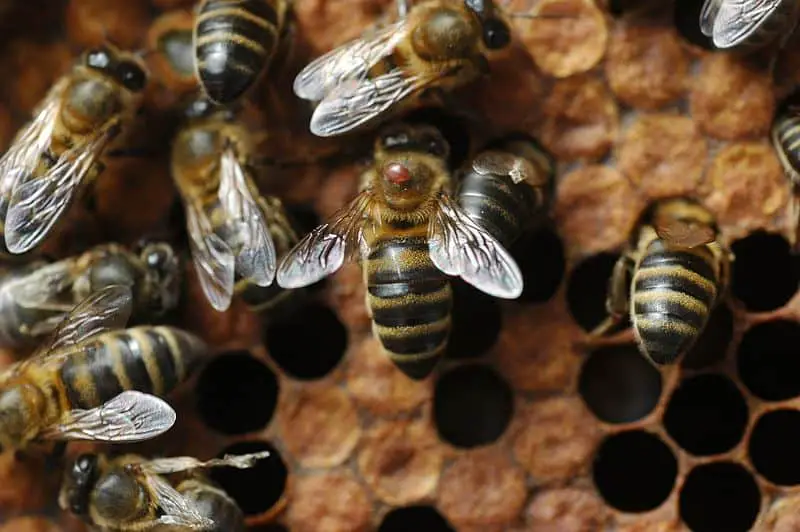
The varroa mite and the diseases that are associated with it have killed millions of our honey bees in the last few decades. This mite originates in Asia, where it is a parasite of the eastern honey bee. It made a move over to the western honey bee sometime in the last century and since then it has spread around the world. It is believed that the mite had made its way to North America during the 1980s. Most of the beekeepers have to face it sometime in their lives. Let me show the ways I have found on how to get rid of varroa mites naturally.
So, how do you get rid of varroa mites naturally? The most common, natural approach to treating bees with varroa mites is to dust them with powdered sugar. After the sugar is applied, the bees will immediately start grooming themselves and each other in an effort to remove the sugar from their bodies. In doing this, they knock off the mites. The powdered sugar itself also prevents the mites from maintaining a good grip on their host.
Taking a natural approach to varroa mite treatment ensures that we are not damaging the precious balance of our ecosystem with harmful chemicals and insecticides. These are substances that we do not want in close contact with the honey that we eat! Let’s take a look in more detail at the varroa mite itself so that we can better understand the situation. From here we can begin to create our approach to preventing and treating this problem within our hives.
WHAT IS THE VARROA MITE AND WHY IS IT SUCH A PROBLEM?
The varroa mite is also referred to as the varroa destructor. It is a common and highly damaging parasite that feeds on the blood of honey bee pupae and adults. The mite is dependent on the honey bee and cannot complete its life cycle without being in contact with this type of bee. It transmits bacteria, pathogens and diseases that can reduce the life expectancy of bees, as well as causing entire colonies to collapse. The varroa mite continues to be considered the most devastating parasite of honey bee colonies currently in existence.
The varroa mite was first noticed in Europe around the 1970s, and since then it has caused massive deaths of bee populations because the western honey bee is not used to defending itself against this parasite. As a result, the varroa mite is the parasite with the most significant negative economic impact on the beekeeping industry. However, the death of honey bees is clearly not just a disaster for beekeepers. All over the world, honey bees are the main pollinators of important food crops such as apples, pears, oilseed rape, almonds as well as many different types of vegetables.
CAN YOU SEE VARROA MITES?

If you look carefully, varroa mites can be seen by the naked eye. They look similar to ticks, with the adult female being a reddish-brown color and the male being paler. Varroa mites are flat and have a button-like shape. They are about the size of a pinhead, between 1–1.8 mm long and 1.5–2 mm wide. They have eight legs.
WHAT ARE THE SYMPTOMS OF A VARROA MITE INFECTION?
Once honey bees are infected with varroa mites, there are two main ways in which the bees may be damaged. Firstly, the mite’s consumption of the bee’s body fat weakens both the adult bee and the larva. Adult mites live under the abdominal plates of adult bees, sucking on the bee’s body fat for energy.
As the body fat is essential for many bodily functions like poison resistance, the bee is left in a very weak state. Open wounds that are left by the feeding mites often become sites for other injuries and infections. Secondly, the mites are carriers of various viruses, particularly the ‘deformed wing virus’. Bees infected with this virus rarely live more than 48 hours and are usually ejected from the hive.
Here are five key points to look out for when you are observing your hives and trying to determine if varroa mites are a problem.
- Do you see brown or reddish spots on otherwise white larvae?
- Are any of the newly emerged bees badly disfigured? You may notice some bees with deformities such as stunted abdomens or misshapen wings.
- Are you seeing bees discarding the larvae and pupae?
- Can you see the small, tick-like mites on the on adult bees? They are usually found attached behind the bee’s head or resting between the bee’s abdominal segments.
- Did your colony suddenly die in late autumn? If this is the case, you are too late to solve the problem this year, and you will have to start again with a new colony when spring arrives.
HOW DO I TEST FOR VARROA MITES?
Unfortunately, it is not always wise to rely on a simple visual inspection to determine if your hive has a mite infestation. Once a beekeeper is seeing mites on their bees, it is possible that the infestation is already serious. For this reason, beekeepers need a reliable way to estimate how many mites are living in the hive. Regularly testing for varroa mites allows us to keep track of the level of infestation within our hives, and it also enables us to learn more about how these levels shift through the seasons.
The following method allows you to test for varroa mites without harming any of your precious bees.
Sugar shake method
- Harvest 300 bees – this will look like around half a cup. Ensure that you haven’t accidentally taken the queen!
- Pour the bees into wide mouth glass jar fitted with a mesh lid. (#8 mesh hardware cloth).
- Add 1 – 3 tablespoons of powdered sugar into the jar and then gently shake it.
- Now gently shake the sugar through the mesh lid and out of the jar onto a white surface.
- Release your sugar-coated bees, being cautious because they will be fine and alive if you have been careful with them, but they may be a little unhappy about this experience!
HOW DO I TREAT MY BEES FOR VARROA MITES USING POWDERED SUGAR?
This natural treatment for controlling varroa mites involves dusting the bees with powdered sugar. It is advisable to find a pure powdered sugar without added corn starch, which is a common addition to cheap supermarket brands. If you buy from a specialist supplier, ask them specifically for pure sugar.
Ensure that you have a varroa screen, a slatted bottom board, or at least a sticky-board insert with a mesh cover in place. This means that any mites falling from the bees will not be able to climb back into the hive or onto another bee after their fall. It also allows you to observe the number of mites that have been removed by the sugar treatment. If you do not have such board yet, I strongly recommend you considering it. It will help you not only to battle the mites but hive beetles too. I use the following and am really happy with it – see on Amazon. And here is the method to use:
- Sift a pound of powdered sugar using a baking flour sifter. Do this at least twice to ensure that there are absolutely no lumps. This should be done on a dry day with low humidity.
- Put the sifted sugar into a clean and empty sugar, salt or baby powder container. You can add some rice to prevent humidity.
- Smoke and open the hive.
- Remove the frames one by one and dust the bees with the sugar. Be sure to avoid dusting any open cells.
- Put the dusted frame back into the hive and repeat this process until you have treated all the frames.
- When this is complete, you may want to put a little extra dusting of sugar along all the top bars.
ARE THERE ANY OTHER NATURAL WAYS OF TREATING VARROA MITES?
Although the sugar treatment is the most common method, there are other techniques that can be used as well.
Split off the nucleus colonies. The act of propagating your hive appears to slow down mite reproduction, because splitting causes a pause in brood production within the hive. If the bees aren’t producing brood, the mites can die out because they reproduce by laying eggs predominantly on the bee brood.
Try drone trapping. Drone trapping is another way to reduce the number of mites without using chemicals. This technique is based on the life cycle of the varroa mite, and the mite’s preference for drone brood. Drone frames are used to entice the bees to build the majority of the colony’s drone comb in one place. Once the drone larvae are capped, the beekeeper can remove these cells and destroy them. The entire frame can be frozen overnight and returned to the hive the next day. Freezing kills both the brood and the mites.
For best results, ensure that most of the cells are capped when you remove the frame from the hive, but be sure to pull it before the drones and mites begin to emerge. Timing is very important when using this method, because if you don’t remove drone frames before the brood hatches, you will be raising a large crop of both drones and mites!
Different types of frames can be used for trapping drones. Plastic frames embossed with drone-sized cells can be bought, or beekeepers can make their own simple frames that can work equally as well.
WHAT IS THE LIFE CYCLE OF THE VARROA MITE?
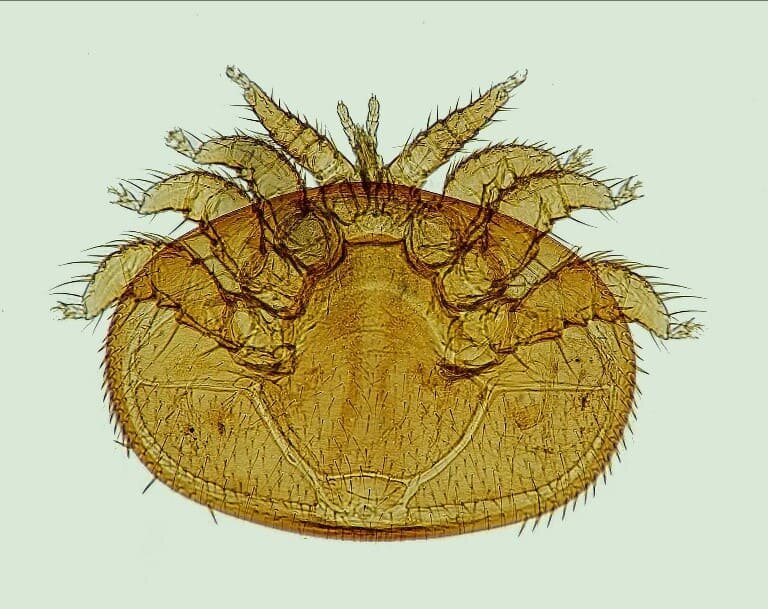
Firstly, the adult female Varroa mite enters the honey bee brood cells at the pre-capping stage. As soon as the cell has been capped, she lays 2 – 5 eggs. These 0.5 mm long eggs are laid on the bottom of the cells or on the walls and are sometime laid directly on the larvae.
The first egg laid is a male, and subsequent eggs are female. After hatching, the varroa mites pass through two larval stages before becoming an adult. It takes roughly 5 to 6 days for males to develop and 7 to 8 days for females to develop. The varroa mites mate in the brood cell, and the male mite dies shortly afterwards.
The young mites hatch at around the same time as the young bee develops, meaning that they can leave the cell with their mother and their bee host. When the young bee emerges from the cell after pupation, the varroa mites spread to other bees and larvae. The daughter varroa mites will lay eggs in other brood cells after 2 weeks. Adult female mites live for around 2 months, but they can overwinter between the hardened plates of the exoskeleton (the sclerites) of adult honey bees.
After these initial developmental stages, mites leave the younger bees for older ones, preferably for a nurse bee. Nurse bees spend most of their time near the brood, and this gives the mites further opportunity to reproduce.
DOES THE VARROA MITE POPULATION GROW CONSTANTLY?
Varroa mite population growth will likely vary throughout the year due to fluctuations in the amount and type of brood present in the colony. In warmer areas where brood is present all year round and drone brood is often present, the population growth of varroa mites will be faster than in areas where the climate is cooler, and brood is not present year-round.
The overall model for the population dynamics of the varroa mite is exponential growth when bee brood are available, and exponential decline when no brood is available.
More female Varroa mites can mature on drone brood because it is capped for longer than worker brood. This means that the reproductive rate of mites increases with the availability of drone brood. In the absence of any brood, the mite population will gradually decline as older mites die and are not being replaced. However, as soon as new brood is produced the mite population will begin to increase once again.
HOW CAN I BE CERTAIN THAT VARROA MITES HAVE KILLED MY BEES?
There are various post-mortem checks that you can carry out to confirm if the loss of your hive was caused by varroa mites. If you have a local beekeeping organization or a wise neighbor, it can be helpful to get a second opinion.
- If you have a bottom board or a varroa tray in place, look here first for mites. If the colony died because of mites, then you will find mites in the debris.
- Find any dead bees in or around the hive and look for bees with deformed wings or abdomens. This is a strong indicator that varroa was the culprit.
- A hive that contains lots of honey but no bees can be a sign of varroa. A hive with honeycombs that have rough edges is a sign that the hive was weak and was visited by robbers. This is also common with a varroa infestation.
- Look carefully inside the brood cells. If you can see white deposits sticking to the inside of brood cells, then you have a sure sign of varroa mites. These white patches are mite excrement.
HOW DO VARROA MITES SPREAD?
The varroa mite spreads to new areas in a variety of ways. It is smart enough to hitchhike its way from an infested honey bee to a healthy and uninfected honey bee. It can also catch a ride with other insects who visit the flowers. At times, honey bees from strong and uninfected hives sneak into the hives of weaker mite-infected hives to rob honey from them. Finally, due to the large-scale nature of industrial beekeeping, there can be a lot of movement of bees and their hives over long distances. Managed hives or recently used beekeeping equipment that is transported into new areas can bring the varroa mite with them.
HOW DOES THE EASTERN HONEY BEE PROTECT ITSELF FROM VARROA MITES?
The eastern honey bee Apis cerana has co-evolved with the varroa mite over time, and as a result it can defend itself from this parasite effectively. The combination of natural defenses that the eastern honey bee has developed against the varroa mite means that this parasite causes relatively little damage to its natural host. It was only when western honey bees were first infected with varroa mites that the potential for its devastating influence become clear.
Here are the ways in which the eastern bee protects itself against the varroa mite.
- Eastern bees have an improved grooming behavior when compared to western bees, which helps them to dislodge and kill the female adult mites from the adult bees.
- The nurse bees can detect infected worker bee broods. They uncap and remove the infested pupae before the varroa mite can reproduce.
- The nurse bees seal up infected cells, and this results in the mites dying as they are trapped inside the cell.
- Eastern honey bee colonies go through extended periods without a drone brood, which causes Varroa mites to go into their phoretic phase and results in the overall mite population dropping.
As always, please let me know if you have any questions related to this post or if you just want to chat about beekeeping! Keep buzzing!
P.S. Thank you for the pic @ piscisgate!