
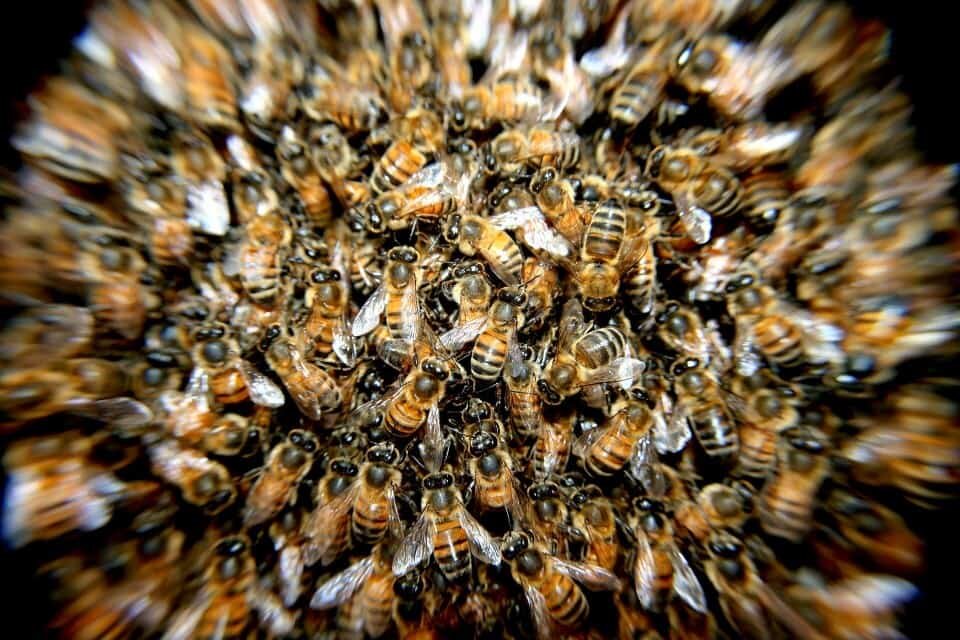
From time to time, you might notice that your bees, which are typically well-behaved, may become aggressive. There are several reasons that these creatures may become agitated and therefore, slightly more aggressive, during certain times of the year, in certain circumstances, and more. Before further research, I was unsure of what exactly contributes to bees becoming more aggressive. At first glance, their aggression may seem arbitrary, but upon further examination, it becomes obvious why bees go through periods of being aggressive and once you understand why this occurs, you can take steps to calm down your beehive and counteract their occasional aggressive tendencies.
Why do bees become aggressive? Bees get aggressive because of the following reasons:
- Your beehive is queenless
- There is a new queen
- The bee colony is growing rapidly
- Nectar dearth
- Incorrect usage of the bee smoker
- Bee colony does not feel safe
- Bad weather conditions
- Bothering the bees too much
- Not enough food
- Beehive is placed in a vulnerable location
How to calm down your beehive? Here are seven tips to calm down your beehive:
- Wear white
- Take your time with your bees
- Remain relaxed while working with your bees
- Open your hives less frequently
- Don’t work with your bees in bad weather
- Keep in mind that bee aggression is temporary
- Use your bee smoker correctly
Why do the bees become aggressive
It is important to remember that bees are not innately aggressive creatures; therefore, a beehive at its origin is not hostile and rather, becomes this way for a myriad of reasons. However, in almost all cases, it is possible to calm down your beehive and reverse the hostile behaviors of your bees, retraining them to become gentler. Once you have isolated the reason why your bees have increased in their aggressive behavior, it is possible to take deliberate steps to relax them.
Usually, the reasons why bees become aggressive will differ from hive to hive. However, if you are noticing that your beehive is behaving a bit differently and aggressively, it is most likely because of one of the below reasons.
Your beehive is queenless
Bees are extremely regimented creatures. If there is the absence of a queen bee, then it is quite common for a hive to display aggressive behaviors. This is one of the leading causes of aggression in a colony
There is a new queen bee
Interestingly enough, bees are similar to us, people, in the way that no two are alike. For this reason, some queen bees are far more aggressive than others, which may have a more style of leading the hive. This behavior can become infectious for the other bees to follow; therefore, if your queen bee is quite aggressive, it is entirely possible that this is the cause of the entire hive hostility or at least the root of it.
If your beehive is aggressive because of the lack of a queen bee, or because the current queen is aggressive, you have to replace the old queen bee and get a new one. Being queenless or under the reign of a feisty queen bee is one of the most significant reasons bees become angry, and their actions reflect this. If you just replaced the queen bee, and the hive is being aggressive, give the bees a bit of time to get acclimated to the new queen. On the contrary, if there is no queen (or she needs to be replaced), be sure to get a marked and mated queen from a reputable source that you trust and have ordered from previously.
The bee colony is growing increasingly large
Has your hive increased dramatically in size over recent months? If so, the rapid increase in the number of bees living in the hive could be to blame for erratic and uncharacteristic behavior. This is because an increased number of bees residing in the hive puts the stress on the pre-existing bees to get enough pollen. During the summer, bees may also become increasingly aggressive due to their need to protect their honey.
In this case, it is important to remember that this is a passing phase and that your hive will eventually become its normal size again. Bees die, and new bees are born to replace them; the cycle of life continues. Therefore, if the hive is slightly oversize and it is causing competition between bees and leading the bees to become hostile, do not worry too much, as the hive will eventually balance itself out.
Nectar dearth
There’s a shortage of honey, and your bees are in a fight or flight mindset. If there is a severe lack of honey, then bees may rob other hives of their honey to sustain themselves. This behavior is decidedly aggressive and therefore, may create a cycle of hostility that can prove difficult to break once it begins. Another possibility is that your hive itself may be getting robbed. This can entirely ruin your beehive so you should pay close attention. Check out my post to understand nectar dearth better – What is nectar dearth and how to survive it?
The stealing of other hives’ bees may contribute to hostile behavior. If you suspect that your bees are getting robbed of their hard-earned honey, there’s a cheap fix: try an entrance reducer to eliminate the amount of space the invading bees can fly in and steal. This makes it more difficult for the bees to fly into the hive. Also, be sure to guard your honey, never leaving it out, and being selective about where to feed your bees and when robbers may be lurking and waiting for the perfect moment to attack.
The bee smoker is being used either incorrectly or not at all
This can be a surprising contributor to the crankiness of your beehive. This is an important tool that is essential to the successful keeping of bees, and it is important that you use it properly to maintain the environment for the bees to be kept. Incorrect usage can result in increased hostility and aggression in the hive.
Your bee colony is feeling unsafe
If there are predators on the prowl that are risking the lives of your bees, then they may become increasingly aggressive as they are always on guard and high alert. This may be a very frequent cause of aggression.
Predators, however, are another issue. If your hive has predators, one suggestion is to put it on a stand. This can help ensure that the predators that are trying to eat your bees and destroy your hive have a more difficult time reaching it.
Bad weather conditions
Very similar to humans, bees prefer weather that is sunny, mild, and temperate. If it is very rainy, windy, or there are other unsavory weather conditions, the bees may become frustrated and therefore belligerent. I recommend to tend to your hive on a day that there are favorable weather conditions, this will help you work with your bees.
If the weather is the cause for your concern, then rejoice! This is the least serious cause of aggression in bees, and also the most fleeting one. If your beehive is more aggressive than it is typically, avoid opening the hive as much as you can during the period of bad weather. When milder, warmer weather resumes, you will find your colony resuming its typical activity and exhibiting its normal behavior.
Bothering with the hive too much
If you have been poking around the hive, then the bees may become frustrated. Consider the fact that if someone came into your home and began poking around, you would become aggravated as well. The bees, though substantially smaller than us, have a very similar response and don’t enjoy when their hives are being too manipulated. Manipulation of the hive may be what is causing your bees to become aggressive.
If this is the reason that you believe your bees are rather agitated, then lessen the number of times that you open the hive and ensure that every action you take is well-considered, thought-out, and deliberate.
Not enough food
If your bees are struggling to survive, there isn’t enough pollen, etc., this can result in frustrated and therefore more hostile bees because they are all feeling the pressure to survive.
As mentioned earlier, starvation is fear and problem that your bees may face. If your bees are starving, you must feed them. This is particularly important during certain seasons of the year when bees have a more difficult time getting a consistent and reliable food supply. It is essential to remember to be tactful where and when you feed them, as you don’t want to put your hive on the radar of predators.
Hive is placed in a vulnerable location
If your bees are constantly facing threats to their survival, then they do increasingly become more agitated and therefore, aggressive. If your hive is in a vulnerable place, you may consider moving it, which is entirely possible. If the colony is constantly under siege of predators that pose a threat to its well-being, moving it could be a worthwhile decision.
Ultimately, there is a wide variety of reasons that your bees may become irritable and therefore, aggressive. It is entirely possible that the cause of the aggression is an interaction of two or more of these causes, and therefore, it is best to consider all options before ruling out what created the hive’s aggression. Another option is to consult fellow beekeepers for their opinions regarding what actions you should take to help restore stability and calm energy in your hive.
Often time, your fellow beekeepers can prove to be the most valuable resource. Getting the opinion of several extremely experienced beekeepers can assist in helping you make the correct decision and getting a more well-rounded idea of what occurred precisely to make your bees aggressive.
How to calm down your beehive
Ok, so we have covered the reasons for bees getting aggressive. I have also shared how to solve these issues, so you don’t bug your bees too much. There are also several steps and precautions that you can take to not only protect yourself in the process but to calm your bees down and have them behave in a more mellow manner if you cannot identify a particular reason for them being aggressive.
Wear white
Skunks are frequently a large predator for bees, as are bears. Therefore, wearing lighter colors, or most ideally, white, will help you as the beekeeper as the bees will know that you are not a predator and be less likely to use their aggressive energy to attack you.
Take your time with the bees
If the bees are already irritated, do not make any sudden movements as you are more likely to frighten them. Move slowly and deliberately. If your actions take longer than typical, or you need to complete a task over a series of a few days or a few hours, that is preferable than the hostile bees becoming aggressive with you.
Remain relaxed while working with your bees
Aggressive and hostile or not, it is important to remember that your bees will respond to the energy that you bring to the hive. If you approach the hive with calming energy, this may not entirely rid the bees of their hostile behavior, but it can seriously assist in managing the situation.
Open your hives less frequently
If you are constantly opening and closing your hive, then they might constantly be in a state of fight-or-flight. To ensure that this is not the case, decide to be very deliberate about when you are going to open your hive and be sure not to open it too frequently, especially when unnecessary.
Don’t work with your bees during bad weather
It is particularly important not to open your hive when there is bad weather on its way, as it can upset the bees and therefore increase their hostility.
Remember that this is temporary
If your bees were originally calm, and then became increasingly hostile, with a little additional care and attention paid to them, over time they will be able to return to their mellow state. Keeping this in mind is essential.
Use your bee smoker
The smoker can be a simply invaluable tool to help easy anxious and on-edge bees. However, if you are using it too much, or not enough at all contributes greatly to the bees’ behavior and disposition. Consult fellow beekeepers to gauge how frequently they utilize their smoker, and work to find the correct balance that works for your hive and bees.
If you have any questions regarding aggression in bees, or are dealing with a specific case of anger and hostility in your bees and would like an objective response, please feel free to use the contact form and reach out to me to further discuss your hive’s wellbeing.
